


Structure and management
Operating procedures
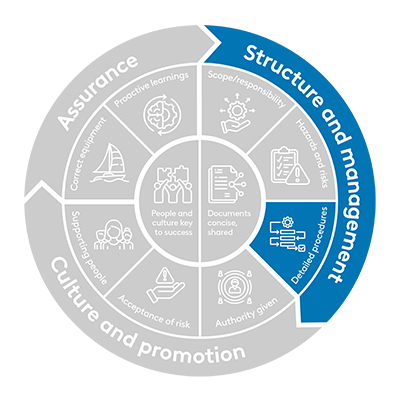
Definition
The way you do things to remove or minimise the risks you have assessed and documenting them in a way that sets out what people need to know, what they need to do and the steps you want them to follow to keep everyone safe.
Every activity you deliver should have a plan that details the safety arrangements in place. It may be written down.
Steps
Guidance
Engage your volunteers and staff in the process of creating and reviewing your procedures – gaining their perspective of what is reasonable, practical and acheivable is more likely to see ways of working followed.
A safety plan for each session informs people what to expect, their role, what to do in certain circumstances, the decision-making framework, and gives people the opportunity to raise any concerns. The plan is likely to include the briefing schedule, details of getting to and from the sailing area, safety fleet positioning, communication and an emergency action plan. Some of this may be included in your operating procedures, particularly for repetitive activities / sessions.
Wireframe
Consider the following content for your procedures
- Pre-session – the resources needed, what to include in safety plans, and whether any local stakeholders need to know about your activities
- Operating areas – the sailing areas you use, any local hazards and bylaws, emergency access and evacuation points
- Participants – if and how they are required to book, the data you ask for, what to include in joining instructions, and the risk statements you give them to help their decision making
- Manual handling – the training required and steps to follow if people or equipment needs moving or handling
- Roles and responsibilities – they key roles, who appoints to them, what is expected, the competency required, crewing levels, and any equipment or clothing required.
- Supervision – establish how and to what level participants are supervised
- Vessels and equipment – who decides who can use what equipment, the competency required, user guides, repair and maintenance schedules, and reporting faults or breakages.
- Decision making – who has been given authority to lead sessions, the framework for decision making and what you expect to be recorded.
- Managing incidents – first aid arrangements, dealing with head injuries, recording accidents, incidents and near misses, and your emergency action plan (including who decides to call the emergency services)
- What to do if – setting out how you expect a range of situations to be dealt with (including changing conditions, accounting for participants, incidents on the water, gear failure, other water users, launch and recovery)
- Debriefs – when and how you give people an opportunity to reflect on what happened, raise any concerns and learn for next time.
Checklist
☐ Have the operating procedures been shared with staff and volunteers?
☐ Do your staff and volunteers know what to do, follow procedures, and suggest improvements to ways of working?
☐ Do you have operating procedures covering all the activities you deliver?
☐ When were the procedures last reviewed and updated?
☐ What can you observe happening day to day that you can trace back to your procedures?
☐ Is there anything in the procedures that isn’t being or can’t be implemented?
For any given session or event do those involved know:
☐ When and how decisions will be made?
☐ The plan for the session?
☐ Their role and the decisions they make?
☐ Each other well enough to ask questions or raise concerns about the plan?